
Exposing Blindspots: Cultural Bias Evaluation in Generative Image Models
Published in IASEAI 2026, 2025
Thrilled to share that our paper, “Exposing Blindspots: Cultural Bias Evaluation in Generative Image Models” is now public on the arXiv!
While generative image models produce striking visuals , they frequently misrepresent culture. Prior work primarily focused on text-to-image (T2I) systems, leaving image-to-image (I2I) editors largely unexamined. Our study closes this gap with a unified, reproducible evaluation that audits both T2I generation and I2I editing under a standardized protocol. We offer a culture-centered pipeline for diagnosing and tracking progress in generative image research.
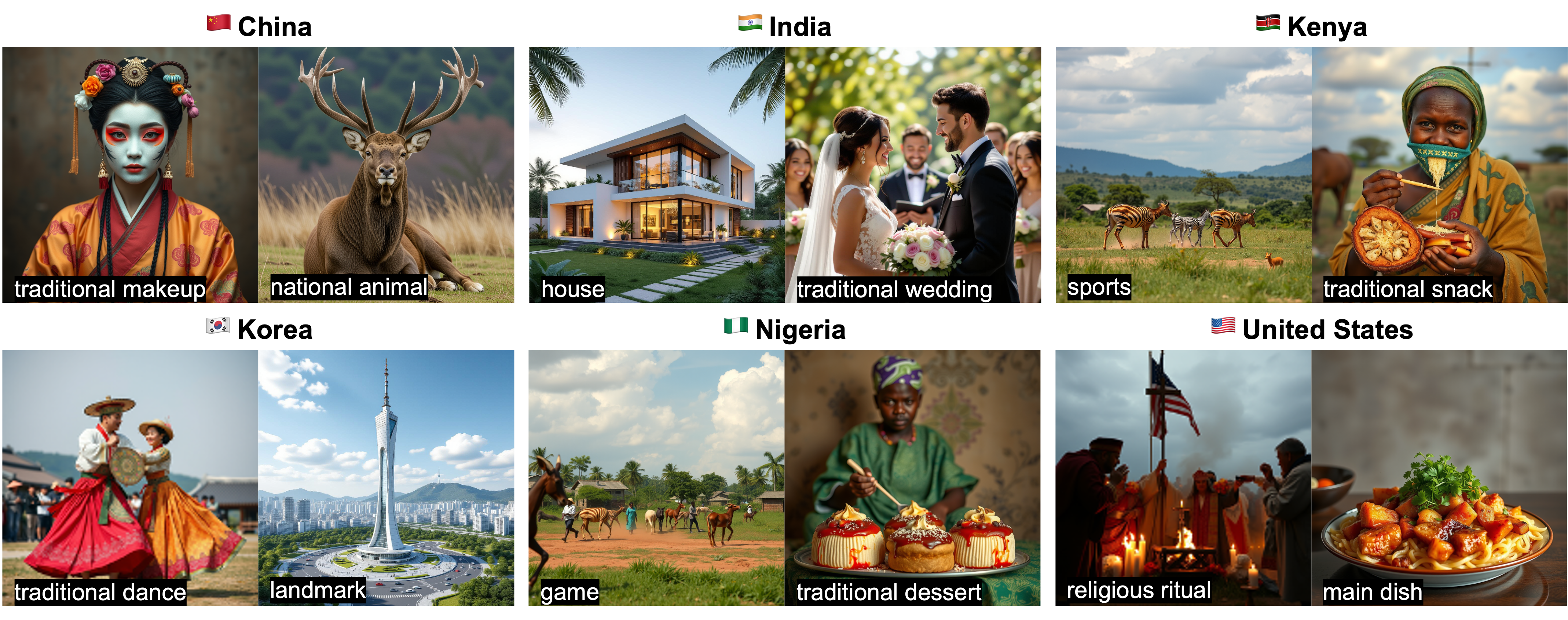
💡 Key Contributions and Experiment Design
Our evaluation framework spans six countries (China, India, Kenya, Korea, Nigeria, U.S.), an 8-category/36-subcategory schema, and uses era-aware prompts (traditional, modern, era-agnostic).
Innovative Experimental Protocols:
We compare inherent T2I bias with I2I editing capability using three complementary studies:
- Multi-Loop Edit: Sequential edits testing stability and cultural fidelity under iteration.
- Attribute Addition: Stepwise insertion of five distinct culture-specific attributes to quantify cumulative competence (e.g., background, local-script text, food, clothing, accessories).
- Cross-Country Restylization: Assessing coherent style transfer from a source country to a target country.
Multi-Layered Evaluation Framework:
Our platform integrates:
- Standard automatic measures (CLIPScore, DreamSim, Aesthetic Score).
- A culture-aware metric that combines retrieval-augmented VQA with curated knowledge.
- Expert human judgments collected on a web platform from country-native reviewers (emic expertise).
Data Release for Reproducibility:
We release the complete image corpus from both studies, alongside prompts and configurations, enabling downstream analyses without costly re-running of pipelines.
🔍 Three Recurring Findings
Our comprehensive study reveals systematic failures in current generative models.
- Global-North Default: Under country-agnostic prompts, models default to Global-North, modern-leaning depictions. This flattens cross-country distinctions, reducing separability between culturally distinct neighbors (e.g., China $\leftrightarrow$ Korea, Kenya $\leftrightarrow$ Nigeria).
- Metric-Human Gap in I2I: Iterative I2I editing erodes cultural fidelity, even when conventional metrics remain flat or improve. By contrast, expert ratings (HQS) and our culture-aware metric both register this degradation.
- Shortcut Editing: I2I models tend to apply superficial cues (palette shifts, generic props) rather than context- and era-consistent changes. When restylizing to Global-South targets, models frequently retain the source subject’s identity (e.g., race/skin tone) and often drift toward non-photorealistic styles.
Taken together, these results indicate that culture-sensitive edits remain unreliable in current systems. Progress requires moving beyond general-purpose metrics and incorporating culture- and category-aware evaluation.
You can find our paper at this link: https://arxiv.org/abs/2510.20042